 Track Order


Vegetable Dicing Machines
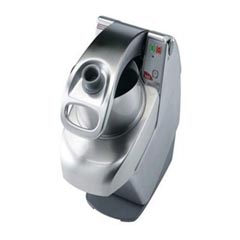
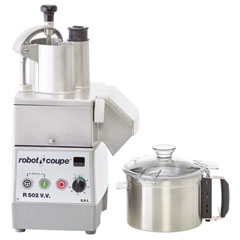
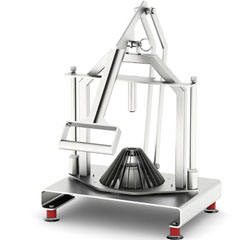
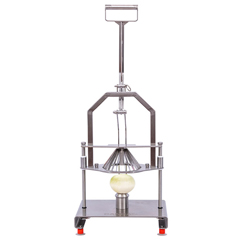
What Is a Vegetable Cutting Machine and What Does It Do?
A vegetable cutting machine is an electric piece of kitchen equipment that quickly cuts vegetables and fruits into the desired size and shape. Thanks to interchangeable blade and disc sets, it combines processes such as slicing, dicing, julienne cutting, and grating in a single machine; preparation that would take hours by hand can therefore be completed in minutes. It is preferred in restaurants, hotels, catering companies, and mass catering operations because it maintains consistent cuts, reduces staff workload, and minimizes waste, especially during busy service hours.
What Are the Advantages of Using a Vegetable Cutting Machine?
Its main advantage is that it shortens preparation time while keeping the cut size consistent. A cutting task that would occupy two or three people throughout the morning when done by hand can be completed much faster by a single operator, and because the slices come out at the thickness specified by the fitted disc, there is no difference between the morning chef's work and the evening chef's work. Pieces of equal size cook in the same amount of time, reducing the need for constant monitoring at the stove. Presentation also improves. For staff, the fatigue and risk of cuts caused by holding a knife for hours are largely eliminated, and labor costs decrease because the same preparation can be handled by a smaller team. Uniform cutting also limits the amount of vegetables discarded, which directly affects ingredient costs. Since the stainless steel body and removable, washable parts do not make daily cleaning difficult, this detail works in the business's favor during hygiene inspections.
What Types of Vegetable Cutting Machines Are Available?
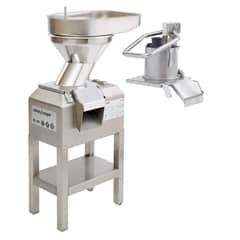
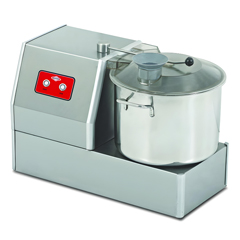
Vegetable cutting machines vary according to capacity, cutting style, and the kitchen's production volume. Countertop models meet the daily needs of small cafés and boutique restaurants, while floor-standing industrial units capable of processing several hundred kilograms per hour are manufactured for hotel kitchens, catering companies, and prepared-food production facilities; their motor power and body durability are increased accordingly. In terms of cutting, multifunctional models that combine slicing, dicing, julienne, and grating discs are the most widely used. Machines dedicated to a single task form a separate group; onion cutting machines, potato slicing and French-fry cutting units, and specialized models designed for soft products such as cucumbers and tomatoes fall into this category. The feeding system is also decisive in the selection, because machines with hoppers and continuous feeding are suitable for high-volume production, while bowl-type models are intended for businesses working with smaller batches.
Most Preferred Vegetable Cutting Machine Models
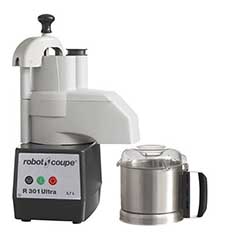
The most preferred models in the industry are countertop vegetable cutting machines with disc blades, tower-type vertical cutters, and combination units that also offer cutter functionality. Restaurants producing 100 to 300 portions per day generally choose compact, single-phase countertop models with a capacity of 200 kilograms per hour. Robot Coupe, Sirman, Fimar, Empero, and Öztiryakiler are among the brands widely used in this segment. Catering companies and hospital kitchens engaged in mass meal production, on the other hand, demand industrial models that exceed 500 kilograms per hour and feature three-phase power and large feed openings. Combination machines stand out in kitchens with limited space. Because both cutting and cutter operations are performed in a single body, there is no need to make room for a second machine on the counter. During purchasing, the number of discs supplied with the machine is just as important as its capacity. Most businesses look for 2, 4, and 8 mm slicing discs together with grating and julienne discs. A body made from 304-grade stainless steel delays wear under the demands of daily washing.
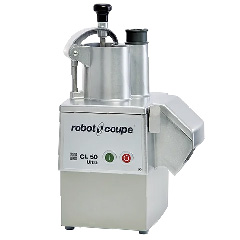
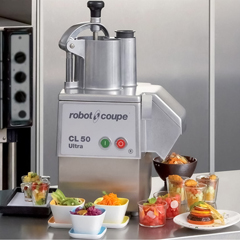
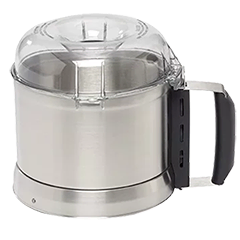
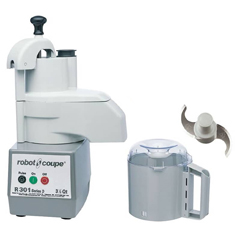
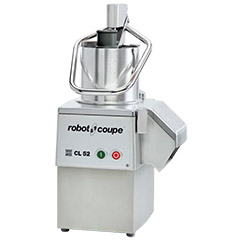
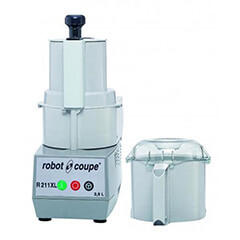
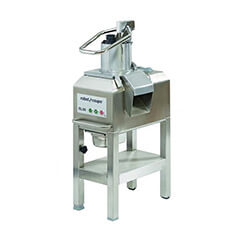
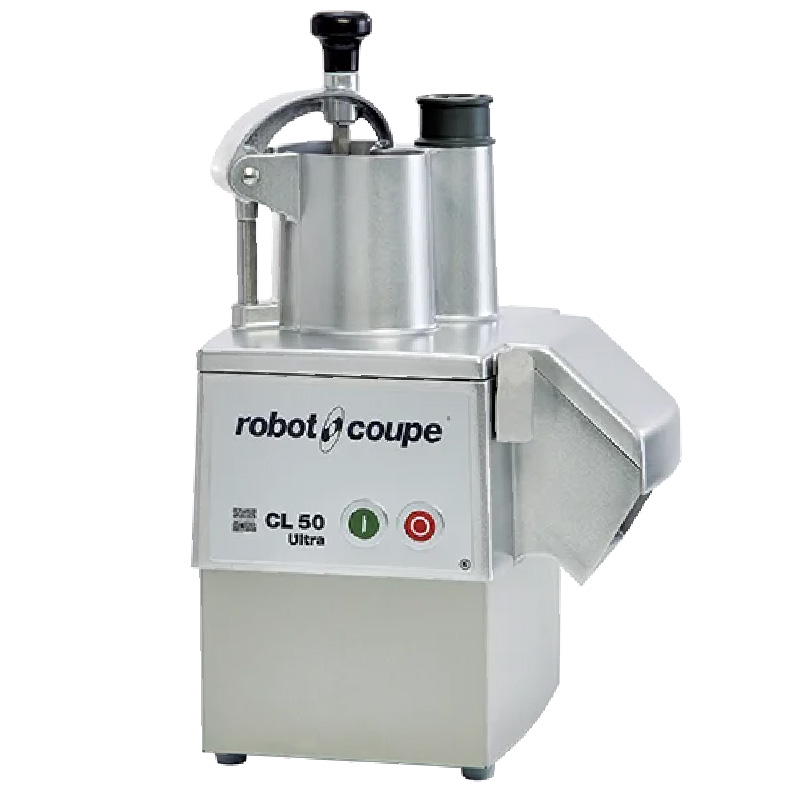
Robot Coupe CL 50 Ultra Vegetable Cutting Machine
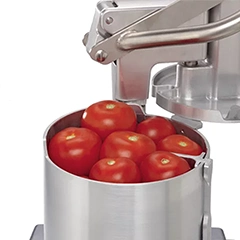
The Robot Coupe CL 50 Ultra is a countertop vegetable cutting machine with a capacity of 250 kilograms per hour. Its 550 W industrial asynchronous motor connects to a 230 V single-phase supply. The large 139 cm² feed opening accepts bulky products such as cabbage and celeriac without requiring them to be cut into pieces, and up to 10 tomatoes can be processed through the same opening at once. The 58 mm diameter cylindrical feeder is intended for long, delicate products such as zucchini, cucumbers, and mushrooms. The 39 mm Exactitube pusher allows small items such as strawberries, grapes, gherkins, and spring onions to be cut without scattering. The motor housing and shaft are stainless steel, and because the motor is mounted on ball bearings, vibration and noise remain low. The absence of carbon brushes eliminates periodic part replacement. Measuring 38 x 30.5 x 59.5 cm, the machine discharges from the side and occupies little counter space. The machine weighs 18 kilograms and does not include a disc; more than 50 disc options can be purchased separately according to need.
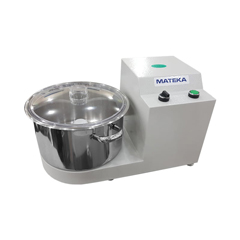
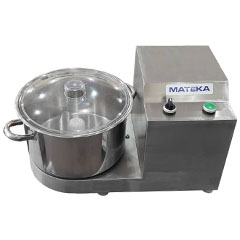
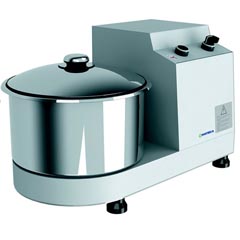
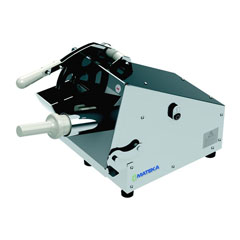
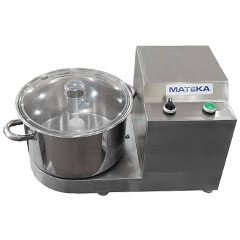
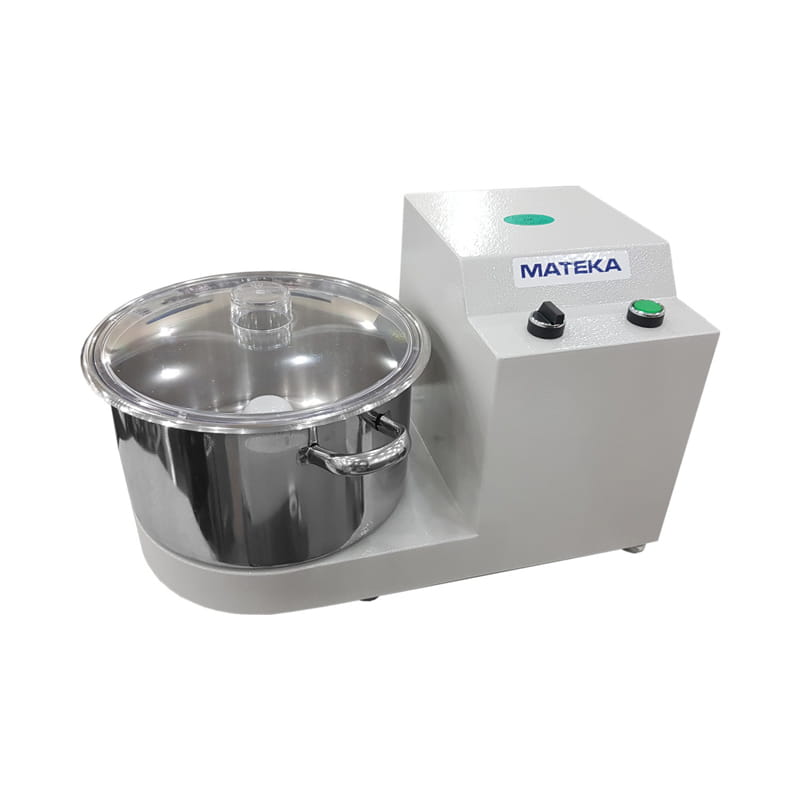
Mateka SGE 260 Vegetable and Onion Cutting Machine
The Mateka SGE 260 is a single-phase vegetable and onion cutting machine with a 7-liter bowl. Its 370 W motor connects to a 230 V single-phase supply, so it does not require additional electrical infrastructure. The bowl, which is Ø260 mm in diameter and 140 mm high, closes with a transparent polycarbonate lid, allowing the ingredients to be monitored during processing without opening the lid. The machine offers two operating modes: continuous and pulse. The pulse mode is especially preferred by kitchens that want a coarse onion chop without releasing excess liquid. The blades are stainless steel, and because the blade and bowl assembly can be removed, end-of-shift cleaning takes little time. The body is made from 430-grade painted sheet metal, and plastic feet prevent the machine from slipping on the counter. Measuring 33 x 55 x 33 cm and weighing 15 kilograms, the machine can be positioned comfortably in businesses with limited counter space.
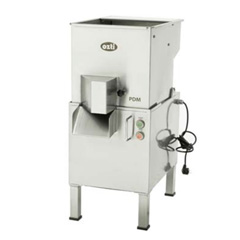
Öztiryakiler PDM Potato Cutting Machine
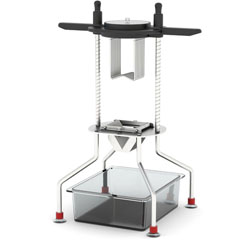
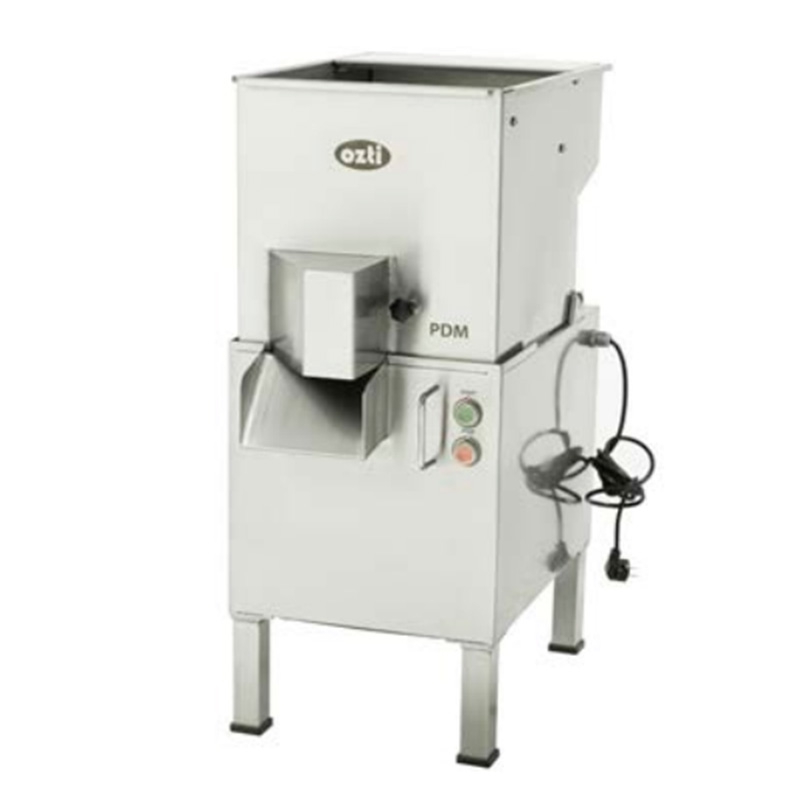
The Öztiryakiler PDM is a vertical cutting machine that automatically cuts peeled potatoes into French fries. It operates with 0.37 kW of motor power and connects to a 230 V single-phase supply. Because the blade design can be adjusted, cuts of 8, 10, and 14 mm can be produced, and the blades are easily removed for cleaning and replacement. The hopper capacity is approximately 13 to 15 kilograms, and when operated with continuous feeding, the machine reaches a cutting capacity of 1,000 to 1,500 kilograms per hour. These values are calculated on the basis of potatoes measuring 8 x 12 cm. The potato's geometry, density, position in the hopper, and the selected blade type affect the actual capacity. An unsuitable combination may cause a blockage inside the hopper; in this case, the machine is stopped, the potatoes are removed, and the hopper is opened to clear the problem. Feeding must be carried out while the machine is running. The entire body is made from stainless steel, and the machine can be integrated with the PSM 30 peeling machine. Measuring 39 x 68 x 90.5 cm, the machine weighs 47 kilograms.
Boğaziçi BSA Vegetable Cutting Machine
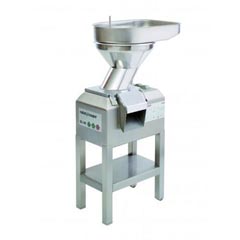
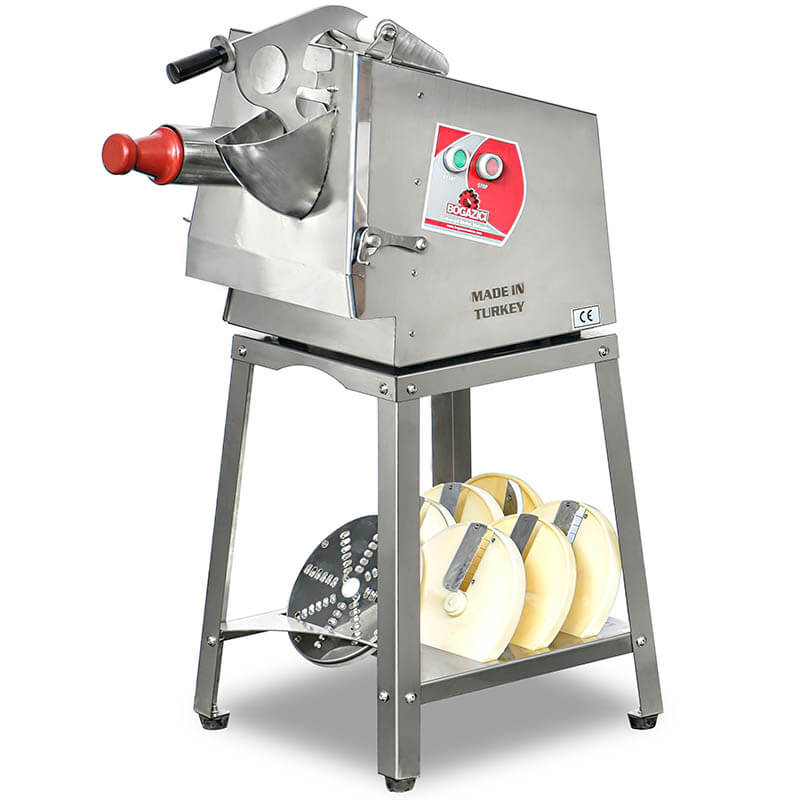
The Boğaziçi BSA is a floor-standing vegetable cutting machine with a body made entirely from stainless steel. The machine has two separate feed chutes. The larger chute accommodates bulky products such as cabbage, celeriac, and beetroot. Cucumbers, carrots, and leeks are placed vertically in the narrow chute. Because the product does not tip sideways during cutting, slice thickness remains consistent from the first piece to the last. Kitchens that require dicing can also add a dicing blade set to the machine. Businesses preparing garnishes, operating a busy salad section, or cutting vegetables for soups frequently request this set. The blade and chute are removed by hand, allowing end-of-shift cleaning to be completed in a few minutes. The stainless steel body does not corrode even when it comes into contact with water and detergent several times a day. The machine measures 790 x 530 x 920 mm and weighs 30 kilograms. It is positioned at a fixed workstation in the kitchen.
Which Cutting Discs Are Used in a Vegetable Cutting Machine?
The disc groups most commonly used in vegetable cutting machines are slicing, dicing, julienne, and grating discs. Slicing discs are generally produced in thicknesses ranging from 1 to 10 millimeters and are preferred for products such as cucumbers, potatoes, and tomatoes. Dicing is performed by operating a slicing disc together with a grid blade and is used for vegetables prepared for soups and garnishes. Julienne discs produce thin, long strips and are suitable for firm products such as carrots, celeriac, and beetroot. Grating discs are divided into coarse and fine types and are especially useful for cheese and carrots. There are also serrated discs for wavy cuts, square grids for French fries, and special sets for cutting onions. Stainless steel discs selected in the correct size for the machine model are essential to both cutting quality and service life.
What Is a Multifunctional Vegetable Cutting Machine?
A multifunctional vegetable cutting machine is a piece of equipment that can perform multiple cutting styles through a single body by fitting different disc and blade sets. Because changing a disc takes only a few seconds, the same machine can first produce thin cucumber slices and then immediately make soup-sized cubes or grated cuts; this eliminates the need to keep a separate machine for every cutting style. Both the investment cost and the amount of counter space occupied are therefore reduced. This is why restaurants with extensive menus, hotel kitchens, and catering companies turn to this type of machine: different preparation tasks can be completed at the same station. Models vary considerably in their number of discs, motor power, and body material. Before making a selection, the business's daily production volume and its most frequently required cutting styles should be reviewed together.
Vegetable Cutting Machine Selection Guide by Business Type
The first factor to consider is how much produce the kitchen processes each day. In a café serving a few hundred portions daily, a countertop model can sit in a corner of the counter, operate from a single-phase outlet, and require no additional infrastructure. The same machine cannot keep up with lunch service in a cafeteria serving five hundred people; a floor-standing machine capable of processing several hundred kilograms per hour is needed there because the motor is expected to run continuously for long periods and the body must withstand that load. In catering operations, mid-range models with wheeled frames are preferred because the machine is transported from one venue to another. In a business with a limited menu, however, most of the discs supplied with a multifunctional machine may never be used; units dedicated to a single task deliver faster results in this situation. Whether the existing electrical panel can support the machine and how quickly service can be reached in the event of a breakdown are just as important as capacity. All of these products are available from Mutbex.
| Specifications | Robot Coupe CL 50 Ultra Vegetable Cutting Machine | Mateka SGE 260 Vegetable and Onion Cutting Machine | Öztiryakiler PDM Potato Cutting Machine | Boğaziçi BSA Vegetable Cutting Machine |
|---|---|---|---|---|
| Capacity/Hour | 15 Kg | 7 Lt | - | 300 |
| Height (cm) | 59.5 | 33 | 90.5 | 92 |
| Depth (cm) | 30.5 | 55 | 68 | 53 |
| Width (cm) | 35 | 33 | 39 | 79 |
| Weight (Kg) | 18 | 15 | 47 | 30 |
| Power (W) | 550 | 370 | 37 | 0,25 / 0,3 (kW/hp) |
What Should Be Considered When Buying a Vegetable Cutting Machine?
Capacity is the first point to clarify when making a purchase decision; the machine's hourly output must match the kitchen's actual workload. A model whose output falls below the amount of produce processed during lunch service will create a queue at the preparation station. A machine larger than necessary, meanwhile, occupies extra space without delivering value for the amount paid. A stainless steel body and blades are indisputable requirements for food safety, and products without CE certification should be avoided. Motor power and rotational speed should be evaluated according to the products to be processed. Low-powered models quickly struggle in kitchens where firm ingredients predominate, and cutting quality declines accordingly. Discs that can be removed in a single motion reduce the time staff spend cleaning. It is equally important that the body can be washed easily in the dishwashing area. A safety lid and motor protection system are the minimum expected safety equipment, while the availability of replacement discs and an authorized service network are as decisive as price. By researching the options available from Mutbex, you can choose affordable models with functional features and purchase them with confidence.
How Should You Choose a Vegetable Cutting Machine for Home Use?
When choosing a machine for the home, first consider how much kitchen space can be allocated and how many times a week cutting is performed. The hourly capacity of an industrial machine is unnecessarily high for a household of four, and the machine also occupies half the counter. Someone who prepares a salad occasionally can easily meet their needs with a portable manual cutter such as a Lurch model that fits on a cupboard shelf. In households that set a large table every evening, hand operation becomes tiring, so electric models such as those from By Kitchen stand out. Disc variety should be considered next. A machine supplied with slicing, grating, and dicing discs eliminates the need to keep three separate tools in a drawer. There are two points to examine in terms of cleaning: the blades should be stainless steel, and the bowl should be dishwasher-safe. Users with children at home should also look for a safety system that prevents operation while the lid is open.
How Should Restaurants Choose a Vegetable Cutting Machine?
The first factor determining the choice for a restaurant is the number of portions served daily. In a business serving fewer than one hundred portions a day, a countertop model can easily keep up with lunch service. In kitchens exceeding three hundred portions, the same machine would create a bottleneck, so floor-standing machines with three-phase motors are required. Menu variety should be considered next. If cucumber slices are needed in the morning, soup-sized cubes at noon, and julienne cuts for garnishes in the evening, multifunctional machines such as Robot Coupe or Dito Sama models can meet all of these needs at a single station. Cleaning time should not be overlooked either. A stainless steel body and discs that can be removed in one motion significantly reduce the time staff spend washing the machine after a busy service. Preventing the motor from starting while the lid is open is an indisputable requirement for equipment that uses blades. It is advisable to check the availability of replacement discs and the authorized service network before making a decision, because a preparation station that stops due to a breakdown directly affects service.
How Should Catering Companies and Cafeterias Choose a Vegetable Cutting Machine?
For catering companies and cafeterias, the first factor determining the choice is the number of portions prepared for a single meal. A countertop model cannot keep up with lunch service in a cafeteria serving five hundred people. At this scale, floor-standing machines with three-phase motors that process several hundred kilograms per hour are preferred. In catering, it must also be considered that the machine will not remain in a fixed kitchen. Because it will be transported from one event to another, models with wheeled frames and straightforward installation stand out. The number of discs also becomes important at this scale. Because soup-sized cubes, julienne strips for garnishes, and cucumber slices may all be required for one meal, discs are changed frequently, and single-disc machines cannot keep pace with this workload. A hopper-based continuous feeding system prevents the operator from repeatedly refilling the chamber. A motor capable of operating continuously for hours and a body able to withstand this load are the minimum requirements at this scale. The delivery time for replacement discs and whether a service team is available in the region should also be clarified before purchase.
Vegetable Cutting Machine Prices
The main factors determining price are the machine's hourly capacity and motor power. Entry-level countertop models fall within a relatively affordable range among kitchen equipment. Prices rise substantially for floor-standing industrial machines that process several hundred kilograms per hour. Body material is another factor that widens this difference. There is a significant price gap between a machine made entirely from stainless steel and an equivalent model that uses a mixture of materials. The number of discs included in the box is also reflected in the price; sets containing eight or ten cutting discs cannot be evaluated in the same range as single-disc models. Brand, warranty period, and the reach of the authorized service network are other factors affecting the price. The best way for businesses to learn the current price range is to review the product pages or request a quotation from the sales team by specifying their capacity requirements. You can also choose quality models available from Mutbex and save money for many years.
Vegetable Cutting Machine Reviews
Preparation time is the first subject highlighted in reviews; many businesses report that a cutting task taking three people two hours is reduced to half an hour with a single operator. Details of this kind, which catalogue figures do not reveal, show how the machine performs during daily service. Consistency of cut size comes second. When the same disc is fitted, the same thickness is produced in the morning and evening, so plate presentation remains consistent. Opinions differ when it comes to cleaning; models such as Vosco, with stainless steel bodies and discs that can be removed in a single motion, receive higher ratings in this area. Comments about motor power come from kitchens working with firm products, and these businesses favor models with three-phase motors such as the Robot Coupe CL 55 and Dito Sama TR210. The Öztiryakiler Potato Cutting Machine is frequently recommended at establishments serving French fries. The scale of the business must be considered when reading reviews, because a kitchen adequately served by a countertop model with a capacity of 30 kilograms per hour does not have the same needs as a high-volume production facility.
Vegetable Cutting Machine Brands
Robot Coupe, Dito Sama, Öztiryakiler, Empero, and Yazıcılar are among the leading names that come to mind when vegetable cutting machines are discussed. Because these brands serve kitchens of different sizes, the preferred choice varies according to the business's capacity. In small-scale kitchens, Yazıcılar's economical countertop models are sufficient. Businesses with varied menus consider Empero designs offering a broad range of cutting options. Öztiryakiler potato cutting machines occupy a distinct place in establishments focused on fried foods. Hotel kitchens and professional chefs, meanwhile, turn to Robot Coupe and Dito Sama because of their high-capacity models with three-phase motors. Boğaziçi, Bosfor, Vosco, Gtech, Mateka, Remta, Cancan, Özlem Madeni Eşya, and By Kitchen also offer alternatives across different budget ranges. Manual cutters such as Lurch can be considered for low-volume use. Product authenticity, the warranty certificate, and access to spare parts and technical service should determine the brand choice. You can review models from the select brands available at Mutbex and choose a machine suited to your intended use.
Frequently Asked Questions (FAQ)
Can a vegetable cutting machine be washed in a dishwasher?
The discs and bowl can be washed in a dishwasher, but the motor housing must never be washed. The body containing the electrical components should be cleaned only by wiping it with a damp cloth. Unless the manufacturer's manual states otherwise, stainless steel discs and transparent bowls can be washed in the dishwasher without a problem; hand washing is nevertheless recommended to preserve blade sharpness for longer.
Which products cannot be processed in a vegetable cutting machine?
It should not be used for products with hard pits or fibrous structures. Fruits such as olives and avocados with their pits still intact, as well as frozen vegetables, damage the blades. Similarly, hard unpeeled squash, coconuts, and ingredients containing bones should not be processed in these machines.
How much electricity does a vegetable cutting machine consume?
Consumption varies from 250 watts to 1,500 watts depending on motor power. Compact household models generally operate in the 250-600 watt range. This figure rises noticeably for industrial three-phase machines because their motors are designed to run continuously for hours. The monthly electricity cost of a machine used for a few hours each day remains low compared with the labor savings it provides.
How is a vegetable cutting machine maintained?
The basis of maintenance is removing and washing the discs after every use and not reinstalling them before they are dry. Blades left damp begin to develop stains over time. Because dull discs reduce cutting quality, their sharpness should be checked periodically and the disc replaced when necessary. Dust accumulating in the motor's ventilation openings should not be neglected either. A general inspection performed by authorized service once a year significantly extends the machine's service life.
How much produce can a vegetable cutting machine process in a given time?
The time depends entirely on the machine's hourly capacity. On a countertop model that processes 30 kilograms per hour, a 5-kilogram batch is completed in approximately ten minutes. On an industrial machine with a capacity of 300 kilograms per hour, the same amount takes less than one minute. Whether feeding is continuous also directly affects the total time.
Does a three-phase vegetable cutting machine require special electrical installation?
Yes, three-phase machines operate from a 380-volt three-phase supply and therefore cannot be used with a standard household outlet. A suitable electrical panel and circuit in the kitchen must be planned by a qualified electrician before installation. Single-phase models operate from a standard 220-volt outlet and do not require additional infrastructure.
How often should vegetable cutting machine blades be replaced?
Replacement frequency is determined by usage intensity and the firmness of the products being processed. Under heavy daily use, discs begin to dull after an average of one year, while this period is much longer for machines operated only a few times a week. Vegetables being crushed during cutting or uneven slice edges indicate that it is time to replace the blade.
Can a vegetable cutting machine cut onions without making your eyes water?
Yes, the onion's tear-inducing effect is greatly reduced thanks to the enclosed bowl. When cutting by hand, the released gas reaches the face directly, whereas cutting in the machine takes place inside an enclosed chamber. In businesses that use large quantities of onions, this feature makes the time staff spend at the preparation table more comfortable.
Can a vegetable cutting machine also be used to cut fruit?
Yes, combination models can easily be used to cut fruit as well as vegetables. Thanks to their sharp blades, firm fruits such as apples and pears, as well as soft products such as strawberries and kiwis, can be sliced without being crushed. To protect blade life, fruit with its pits still intact should not be fed into the machine.
How much noise does a vegetable cutting machine make?
Operating noise varies according to motor power and body construction. Small household machines produce a level of sound similar to a food processor. Industrial three-phase models are naturally louder. Because these machines are generally operated in preparation areas separate from the service area, guests in the dining room do not hear this noise. A sturdy frame and anti-vibration feet also reduce noise noticeably.
Is technical support required to install a vegetable cutting machine?
Technical support is not required for countertop single-phase models; once removed from the box and plugged in, the machine is ready to use. The situation is different for three-phase and floor-standing industrial machines. Authorized service support should be obtained because the electrical connection must be made to a suitable panel and the machine must be placed on a level surface. Performing the initial startup under the supervision of a technical team is also important for maintaining the warranty conditions.
Can a vegetable cutting machine produce French-fry cuts?
Yes, models fitted with a square grid attachment can easily produce French-fry cuts. Businesses focused on fried foods generally prefer potato cutting machines dedicated to this single task. Because the cutting thickness depends on the grid size, it is important to select an attachment suited to the portion style being served.
What size kitchen is a vegetable cutting machine suitable for?
Suitability is determined more by hourly capacity than by the number of people. A countertop machine processing 30 kilograms per hour meets the needs of businesses serving up to 100 portions a day. Cafeterias serving 500 people require floor-standing machines with capacities of several hundred kilograms per hour. Because the proportion of vegetables on the menu also changes this calculation, the daily quantity processed in kilograms should be considered together with the number of portions.
Is staff training required to use a vegetable cutting machine?
Because the machines are designed to be user-friendly, extensive training is not required, but basic instruction should be provided. Staff must be shown how to install and remove the discs, close the safety lid correctly, and use the pusher. To prevent unsafe habits such as placing a hand inside the feed chute, the first use should be supervised by an experienced member of staff.
How much space does a vegetable cutting machine occupy where it is installed?
The amount of space occupied varies considerably by type. Countertop models take up an area approximately 30-40 centimeters wide. A machine of this size fits easily into a corner of the kitchen counter and requires no additional rearrangement. Floor-standing industrial machines, however, need a dedicated working area. The clearance required for the operator to move comfortably around the machine should also be planned in advance for both efficiency and occupational safety.
How long do vegetables processed in a vegetable cutting machine stay fresh?
When stored under the correct conditions, vegetables processed in a vegetable cutting machine stay fresh for an average of 2 to 3 days. Blade sharpness largely determines this period. Because a sharp blade cuts without crushing the cell walls, moisture loss and discoloration slow down, while the same carrot cut with a dull blade begins to darken around the edges within a few hours. We recommend storing processed products in covered gastronorm containers at temperatures between 0 and 4 degrees. Spin-drying vegetables washed before cutting reduces the film of moisture on the surface and delays microbial growth. When vacuum packaging is used, this period can extend to 5 days for leafy products such as lettuce and cabbage. Potatoes, celeriac, and apples, which are prone to oxidation, are best consumed during the same shift.